PS #16: Wrapping the Greenhosue

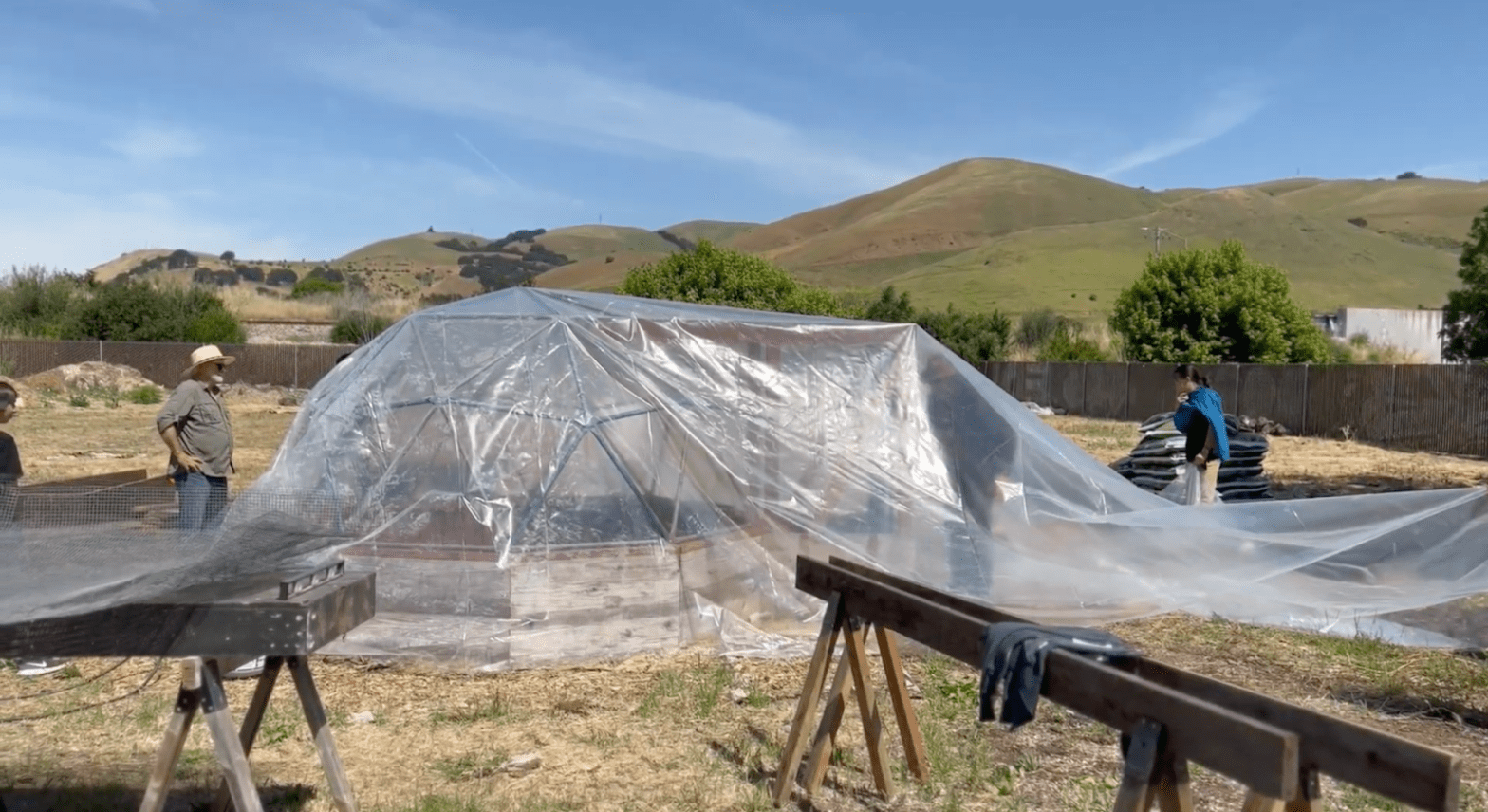
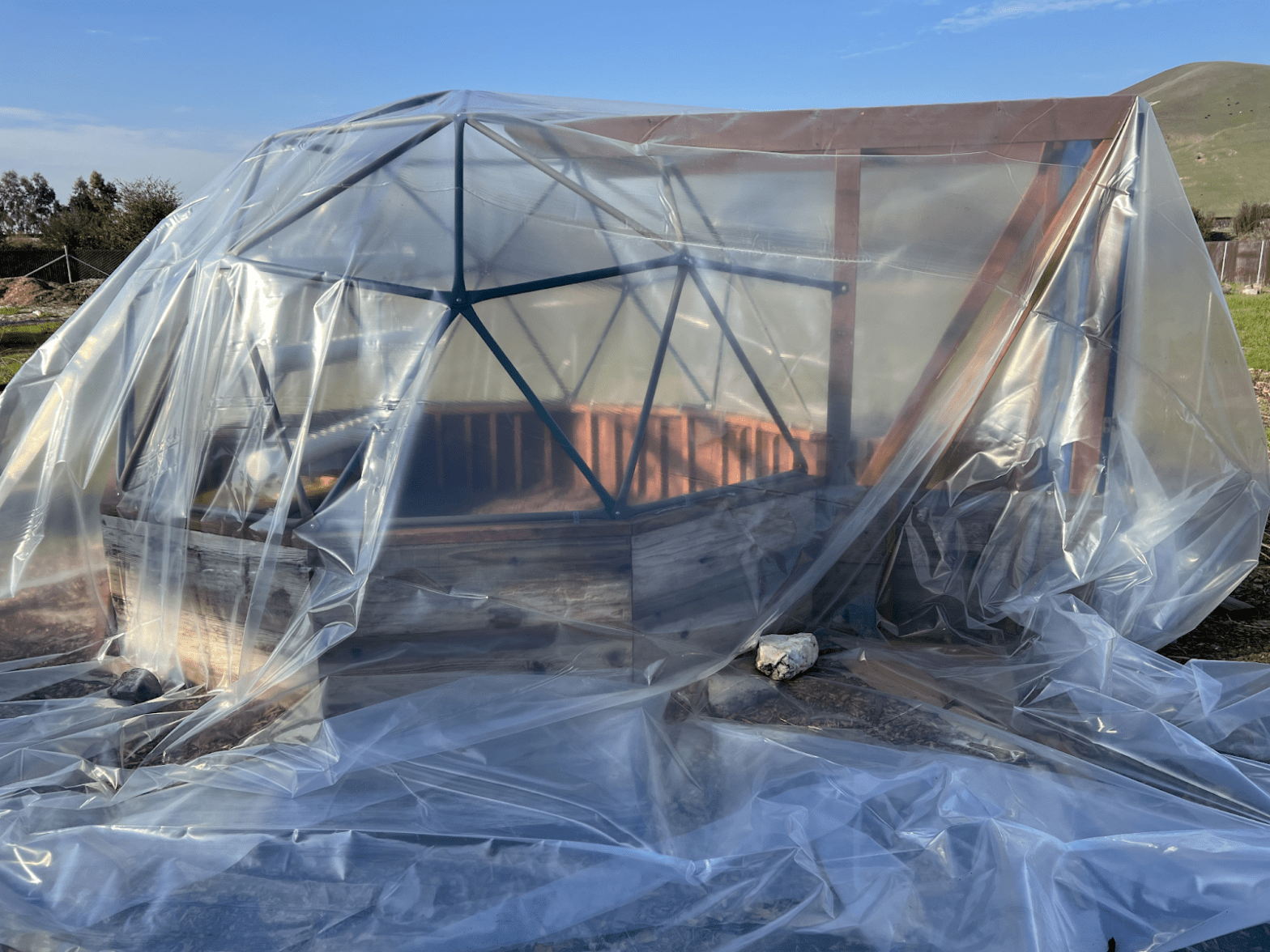
Today is an exciting day! We finally get to cover the greenhouse with the shrink wrap. For any greenhouse to work, you need insulation to help stabilize the temperature. We chose to use shrink wrap because it allows us a greater degree of freedom when covering our uniquely shaped greenhouse.

The way shrink wrap works is that it reacts to heat by shrinking in the exposed area. We had to unpackage the shrink wrap kit, which came with a heat gun and a giant length of shrink wrap. It was so large that we needed at least 5 or 6 people just to unfold it so that we could measure it to see how much we had to work with. It was quite large, so we should be able to get 3 tries out of it before we run out. The heat gun is more reminiscent of a flamethrower with its long body, big handle, and the fact that it connects directly to a propane tank.

We cut off some small pieces to test how quickly and much the heat gun shrinks the wrap and then once we felt comfortable, we attempted to clothe the greenhouse. We had to make a large cut through the length of shrink wrap and with that piece, begin to pull over the dome. We wanted to be as secure as possible, so everyone but the heat gun wielder held the shrink wrap in place. Things were going well, the shrink wrap was tightening around the dome, but then disaster struck; there was now a hole in the wrap. We had to abandon this piece as the insulation has to be airtight. The day was coming to a close, so we had to try again next time.

Grow with the flow!

PS #14: ACWD Interviews

Build Day this week had a performative twist. Aman, our project manager, alerted us to the ACWD WaterClips Student Video Contest. This is a contest where middle and high schoolers send in videos about chosen topics under water conservation to the Alameda County Water District.

While some of us carried out tasks like dismantling planter boxes, a few others tested their speaking skills through practicing for the ACWD contest. Of course we didn’t leave the labor to one group and rotated people periodically.

Overall, recording for AWCD was a blast and educational experience. Being able to talk coherently, whether 1-on-1 like in an interview or a casual conversation or to a group like in a video or a speech, is an important skill to have.

Grow with the flow!

PS #15: How Much Food can the Hydroponics System Grow?

When you create a system, such as our hydroponics greenhouse, you want to plan it out with a model first. For our model, we will just be looking at how much food the hydroponics system should theoretically be able to produce in a year. First, we need to find the value of all our variables for the model, which are simply the number of lettuce and growth period. 

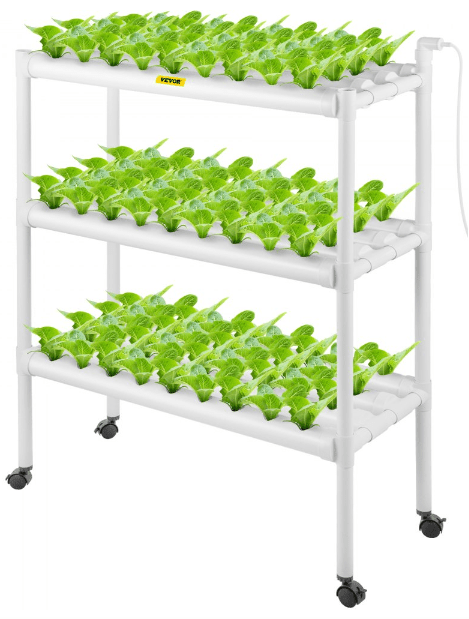
We will be producing butterhead lettuce of which the growth period is about 50-60 days, so let’s just call it 55 days. Now, we can find the number of lettuce by dividing the length of our pipe by the growth space of one head and then multiplying by the amount of pipes. If our pipe is 52 inches long and a head of butterhead lettuce requires 8 inches diameter to grow, then we can grow about 6 heads per pipe, which multiplied by 3 pipes is 18 heads of lettuce. 

With the number of lettuce the system can grow at once and the growth period, we know that it can grow 18 heads every 55 days. Since there are 365 days in a year, we reach the conclusion that we can grow an average of 120 heads of lettuce per year.

Grow with the flow!

PS #13: Mini Hydroponics

Today, we deepened our understanding of hydroponics by creating a scaled-down version of our hydroponics system. Using smaller PVC pipes with pre-drilled holes, we set out to model the entire system. This allowed us to visualize and analyze the flow of water throughout the entire completed system and how efficiently water would reach each plant within the setup.

Since we had smaller PVC pipes with holes in them, we decided to model the hydroponics system to see how exactly the water would flow and how it would provide water to the plants in the system. After figuring out where all the pieces go, we assembled the system and began running water through it.

By making this model, we gained a much clearer understanding of how the hydroponic worked. We learned about the importance of maintaining a consistent flow rate and ensuring that the holes in the PVC pipes are correctly positioned and sized.

Keep calm and keep growing!

PS #12: Hydroponics Explained

When it came to designing our greenhouse, we had some ambitious goals: to be space-efficient, water-efficient, and energy-efficient. We realized that the best way to achieve these goals was by incorporating hydroponics into our system. Hydroponics isn’t just a trend in modern agriculture; it’s a revolutionary method that aligns with our goals of sustainability and efficiency.

By growing plants without soil, hydroponics allows us to maximize space, allowing us to grow more plants in a smaller area. This method also uses significantly less water than growing plants with soil, as the system recirculates water, conserving it and reducing waste. Additionally, hydroponics systems can be optimized for energy efficiency because the entire system can be run with solar energy. This means all its energy comes from a renewable resource. By incorporating hydroponics into our greenhouse, we are able to create a sustainable and highly efficient growing system that meets all our goals.

Keep calm and keep growing!

PS #11: Completed Hydroponics

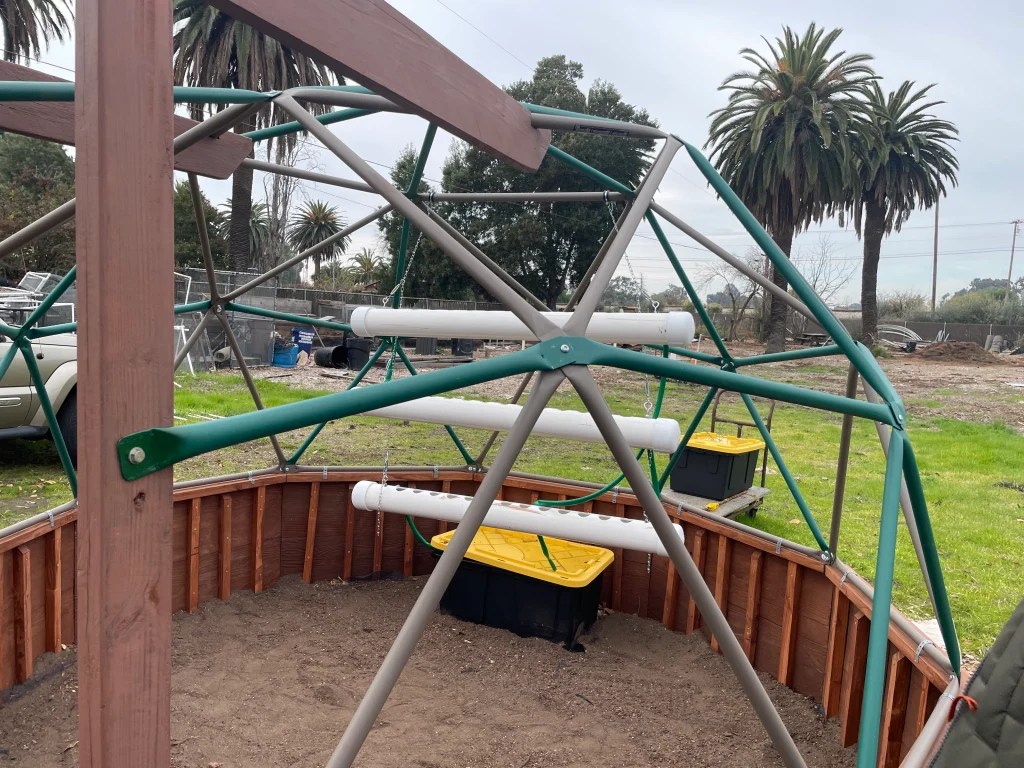
Today, we finished the entire hydroponics system, allowing water to flow seamlessly from the reservoir, through the system, and all the way back to the reservoir. We used the same format as the first pipe to make two other identical pipes. We connected the first pipe with an intake hose attached to the pump, and a second hose which transports water to the second pipe. The second pipe has another hose that transports water to the third pipe after flowing through the second one. The third pipe has a hose that lets water drain from the system and back into the reservoir. However, a problem arose when testing the system for the first time. When the water was getting pumped through the system, the first pipe started to overfill, and no water was going to the second pipe. To fix this, we slightly offset the angle of each pipe so the water was flowing down a downwards slope. Finally, we turned the pump on and water flowed through each pipe and cycled through the entire system successfully.

Keep calm and keep growing!

PS #10: Upgrading The Greenhouse

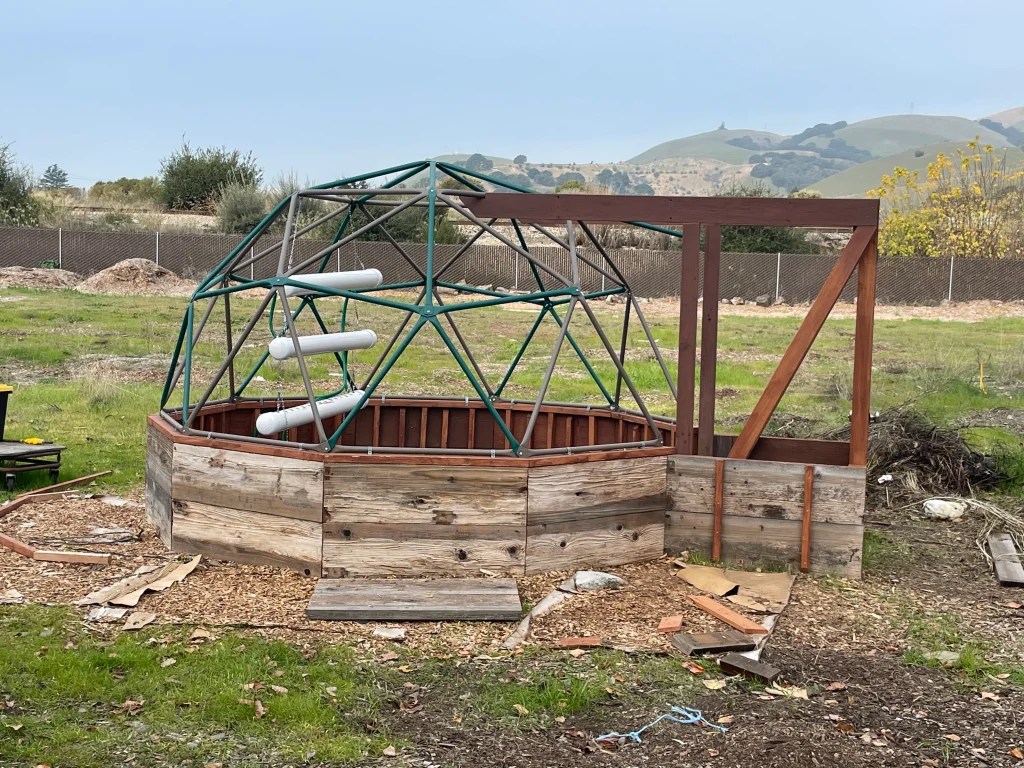
Today, we focused on furthering the greenhouse, making a proper entrance for it, and starting to put together the hydroponics system. To start, we had to make a doorframe to eventually put to the door in. To achieve this, we used the left over planter box wood and cut it to the measurements of the door. Once the frame was put secured to the dome, we had to secure the door into the frame. We used screws and hinges to attach the door to the frame, successfully making a proper entrance to the dome. Finally, we started the hydroponics system. We used chains to allow the pipes to be hung midair so less material had to be used in the system. To create the pipe we used a PVC pipe, drilled evenly space holes, and glued caps on both sides to keep the water inside. Then, we drilled two smaller holes on the left side and the right side of the pipe, one for intake, and the other to flow water into the next pipe. Finally, we attached the pipe to the chains.

Keep calm and keep growing!

PS #9: Completing the Main Structure

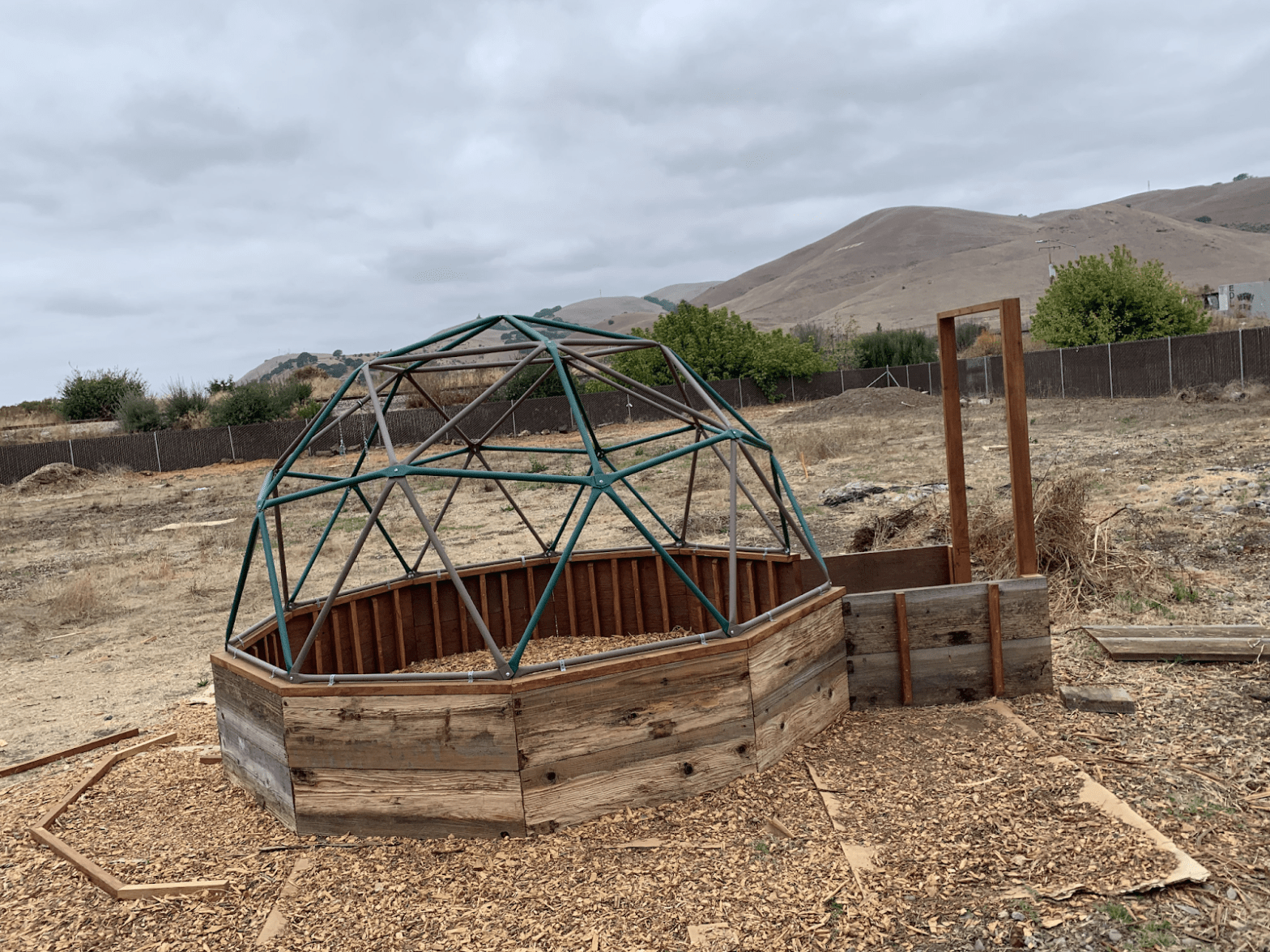
Now that the dome is secured to the inner wall, we needed to trim parts off to make way for the entrance. We essentially removed the pipes that were above the 10th edge of the dome up to the top pipes, which we didn’t touch. Since we were going to append a rectangular corridor to a geodesic dome, we cut some of the connecting pipes to fit.

At the same time, we had a group working on the door frame. We measured out the dimensions of the door and gave a slight gap for the inside measurement of the frame. We also cut out a large roof piece that attaches to the frame and rests on the dome, a horizontal support at the end of the corridor, and a diagonal support for each side.

Once all of these were screwed in place, the structure was sound and we could install the door too. We needed two people, one inside and one outside, to hold the door up as it hovers above the frame, while another person screwed it to the door hinge. With all of this work, the main structure of the greenhouse was done.

Grow with the flow!

PS #8: How we Modeled the Inner Wall

Before we could get started on the inner wall, we needed to have a theoretical model to plan our pieces.

The dome that we chose had 10 edges for the base. This ten-sided shape is a simple decagon and what the wall has to conform to. The amount of degrees in a regular polygon is equal to the product of 180 and the number of edges minus 2 and the interior angle is that divided by the number of edges. This means that a decagon has (10 – 2) * 180 = 1440 degrees and its interior angle is 1440 / 10 = 144. Since we start from straight pieces of wood, we can view the current state as two pieces aligned along the same line, or 180 degrees, which needs to bend to 144 degrees. This means that the angle we need to cut for each piece of the wall is 180 – 144 = 36 degrees, but we also want it to look good and have a little more structure when connected, so we would split this angle into a 18 degree cut on both ends of the wall.

We are not done yet, though, because we need to account for an entrance for the greenhouse, so we basically take out one of the ten pieces of the decagon and bring the ends straight out. For these corridor pieces, there is actually a 90 degree rotation from the orientation of the theoretical 10th piece, so we have to subtract 144 and 90 from 360 which gives us 126 degrees for the angle between pieces. The actual angle that needs to be cut is 180 – 126 = 54 degrees. Both the end and corridor pieces will have a 54 / 2 = 27 degree cut each to complete our inner wall..

Grow with the flow!

PS #7: Getting Back on Track

After last Build Day’s shenanigans with the dome being stolen, we quickly ordered a new one so we could get back to work as soon as possible. We rebuilt the dome today, quite a bit faster than the initial construction, a telltale sign of our improvement, if you ask me.

Now that we were back on track, we could start mounting the dome on the inner wall. It took a team effort of 6 of us to transport the dome onto the wall, as you can see below. When it comes to securing the dome, we chose to use metal hanger straps which allow us to conform to the odd shape of connecting a pipe and flat surface. While this happened, we had a separate team grinding out in dismantling the planter boxes so that we could have more wood for next Build Day.

Grow with the flow!